HIMALAYAN RUN & TREK – AN ENVIRONMENTAL MISSION
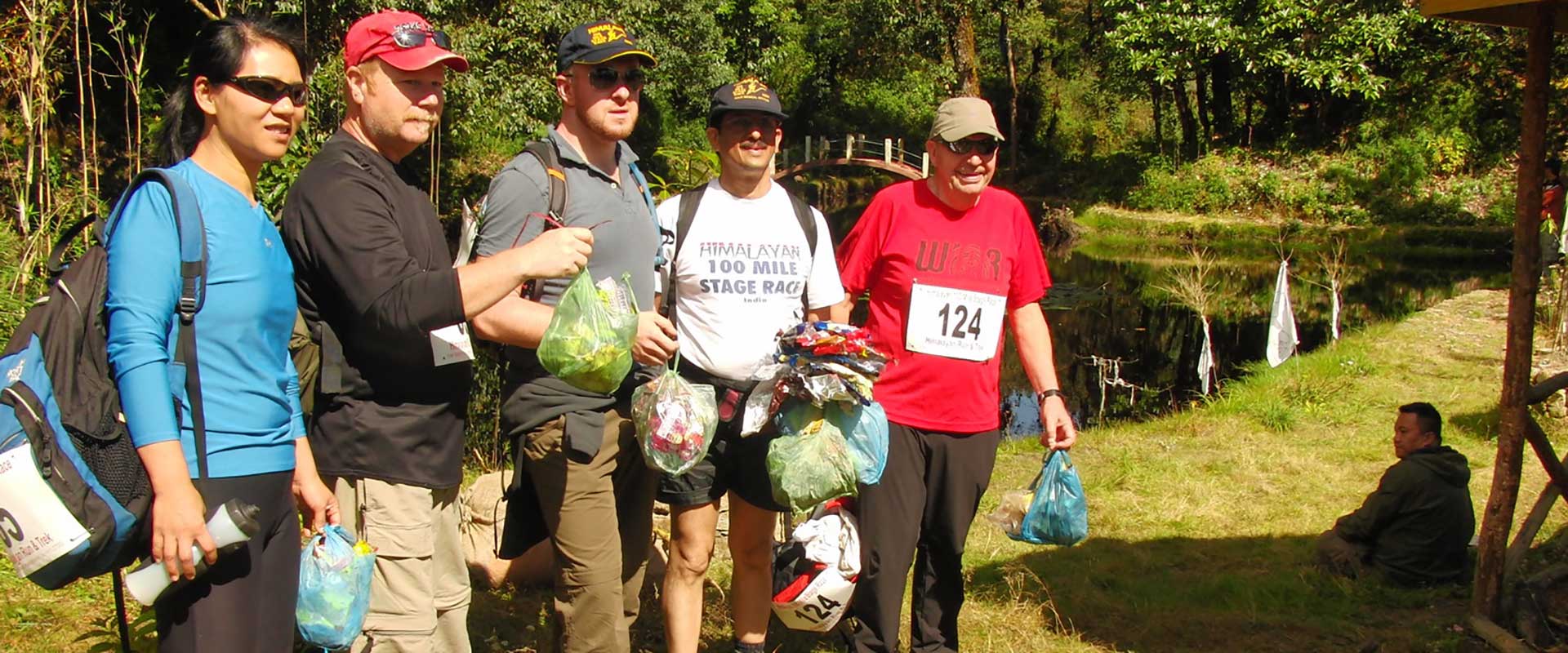
Since the inception of Himalayan Run Trek, one mission has always been kept in mind that activities taken place under the supervision of this organization should be environmental friendly and the echo of Eco should reach every corner of this world. This motive has always been a driving force for HRT and its team to continue its efforts towards conservation and preservation of Himalayan environment for present and future generation by encouraging afforestation, renovation of many ponds in the Himalayan villages at the higher altitude, disposing off the garbage with sound environmental practices, re-establishment of natural habitats of flora and fauna, minimizing the cultural impacts, developing and imparting the concept of maintaining an eco-balance of body and mind, encouraging trekkers and hikers to pick the garbage from the routes left by the other general tourists and disposed off in a proper and environment friendly manner etc.
The organization is also involved in educating the locals about the conservation and preservation of the natural resources in and around them along with the solid waste management.
Mountaineer, Adventurer, Environmentalist, extensive explorer Mr. C.S.Pandey, who is also directing the company as Managing Director has devoted his life to promote the eco – friendly adventure sports activities in the Indian Himalaya. He has great passion to grow plants and has been planting more than 5000 saplings in nearly 20 years while trekking, hiking and exploring in Indian Himalaya and also in Delhi where he lives, which have now grown as fully flourished trees providing fruits shelters. In Delhi, he moves around with small team of enthusiastic people, who frequently visit the shores of Yamuna River and clear the heaps of garbage as much as possible. Also, he has been encouraging the mass of young generation to bring the same passion in them. He says “while traveling in the traverse of Indian Himalaya my inner soul commanded me that God has decided something in his mind for me. Passing through jungles and while crossing rivers, I found certain places, which were degraded and spoilt by the daily use of the trails. The same places were so refreshing and new when I visited them during my school days. This replies the question raised by my inner soul and I was directed to put my efforts to save the environment for the upcoming generation. When I started with this new job, my heart was overwhelmed whereas mind was transmitting the message this path is very difficult. At the same time, lines from Sibnarayan Ray poetry hatted the anxious mind which says:-
- Let the storm arrive
- It will soon pass
- Where we stand
- Our heads lifted to the sky
- There we will stay
- Sending our roots
- Deeper still
- Into the earth.
Since then, I kept on going and every task being done towards the savor of our environment acted like motivational capsules. Following lines from Robert Frost’s poem can be more explanatory:-
wo roads diverged in a yellow wood And sorry, I could not travel both and be one traveler. Long I stood and looked down one as far as I could To where it bent in the undergrowth Then took the other just in the 74undergrowthThen took the other just as fair0 and having perhaps a better claim Because it was grassy and wanted wear Though as for that the passing there It warned them really about the same And both that morning equally lay in leaves No step had trodden
- black Why? I kept the one for another day
- Yet knowing how way leads on to way
- I doubted, if I should ever come back
- I should be telling this with a sigh
- Somewhere ages and ages hence
- Two roads diverged in a word and
- took the one less traveled by.
Environmental mission
The underlying theme of each trip is to present a message of Himalayan conservation through close cooperation with the Government of India Tourist Offices, and every participant of the event and individual who believes in preservation of the areas they visit. The Race Directorate has also developed the concept that the tour operator should prepare specific Conservation Guidelines and provide the Guidelines to all trip participants, guides, and staff in advance of the trip departure. Everybody should be encouraged to follow the Guidelines during the trip with the tour operator ultimately responsible. After the trip, each participant would be given a Questionnaire to complete that would rate the tour operator on how well the Guidelines were followed. The Questionnaires would then be used to measure the impact of the trip from an environmental and economic perspective on the areas visited.
Eco Sports designation
In October 1993, a professional environmentalist, Mr. Bill Antholine, prepared Guidelines and Questionnaires relating to the Stage Race. The tour operator distributed the Guidelines and asked all participants to complete Questionnaires. In August 1994, Mr. Antholine completed a 140 page Eco Travel Case Study of the 1993 Stage Race. Copies of the study were presented to Indian Tourism Officials and others concerned with conservation around the world. The Study was very well received and complimented by senior officials who saw it. In particular, the Secretary Tourism, specifically responded in writing to confirm the Study could be useful in the development of tourism to the North-East HImalayan area, including Sandakphu National Park. For these and other reasons, the running and mountain biking trips have been called the “first EcoSports trips in the world” by environmentalists, tourism officials, journalists, and others.
Broad implications on Tourism
The Mirik Lake Resort is owned and managed by Darjeeling Gorkha Hill Council Tourism Office (DGHC). The Sandakphu National Park is jointly managed by the DGHC Forestry Department and Tourism Department. The mountain huts along the trail to Sandakphu, at Sandakphu, Phulet, Molle, Siri Khola, Rimbik, and elsewhere were constructed and are maintained by DGHC Tourism Department. The walking route follows a historic trail through Sandakphu National Park marking the border between Nepal and India right up to the border with Sikkim (at Phulet Hut). The trail and hut system is designed for trekkers and will readily accommodate runners and mountain bike riders without adversely affecting the natural environment. Public toilets, water supply, hut supervisors, and park wardens are part of the developing infrastructure in this area. The trip you join adds positive impact toward improving this infrastructure. Our staff learn about how to care for tourists, carry trash out, and conserve resources. This learning process is carried over to local villagers directly and indirectly from the trip. Generally, support of DGHC tourism services is support for controlled tourism development with a conservation theme. The international publicity and size of our groups makes a positive impact on tourism development to this area. Before the first Stage Race in 1991, the idea of running in this area was considered impossible by the vast majority of tour and hotel operators in Darjeeling and Sikkim. The Gvnt of India Tourist Office, was almost alone in support for the first Stage Race. Even the second year, the tourism offices were the prime supporters. When the Everest Bike Rally was introduced in 1993, local tour operators and hotel owners said mountain biking in the North-East Himalayan area was “impossible”. There was not one bicycle to found in the entire town. Therefore, the idea of riding to Sandakphu was out of the question. Then the bike riders on the 1993 Bike Rally proved mountain biking was not only possible, but could attract tourism to the area. The Mountain Bike Club (India) was formed in 1994 and now provides free bike itinerary information to anyone upon request. The tour operator presented 6 new Hero bikes to DGHC and one new bike to Sikkim Tourism Department in 1993. DGHC may purchase more bikes for rent to tourists who want to ride around the town. DGHC now produces booklets on adventure activities in Darjeeling that includes running and mountain biking (reproduced in this PDI). Before the running and bike trips in this Brochure, neither sport existed nor was thought possible in Darjeeling. Another important contribution has been the awareness that Mount Everest can be seen from India. This was not widely known before the publicity from these trips started to make Indians and foreigners aware of the fact. More publicity is now given to the fact that four of the five highest mountains on earth can only be seen at the same time from Sandakphu National Park – specifically on the 14 mile ridge line between Sandakphu and Phulet. On the negative side, the increased use of jeeps in the Sandakphu NP may become a problem. Some foreign tourists are starting to ask to visit the area by jeep rather than by foot. A policy should be established in 1995 to deal with this issue. On balance, the annual running and biking events will translate into increasing international exposure for Darjeeling and Sikkim tourism.
Conservation Guidelines
Every person joining any trip is asked to read over the Guidelines in advance of arrival in India, observe how well the tour operator follows the guidelines during the trip, and then complete the Questionnaire before leaving India, and leave it with the tour operator.
Conservation Guidelines
Suggested Guidelines for Achieving an Environmentally Sound Adventure Tourism Industry that can contribute to the sustainable development of the Eastern Himalayan Region. We ask you read the following Guidelines and observe if the trip is operated consistent with them. At the end of the trip, you will be asked to complete a questionnaire essentially rating the performance of the tour operator. The “Himalayan Run & Trek” is designed to be a model for eco-tourism development in the Darjeeling area. By setting and following high international standards for eco-travel, it is hoped that other tour operators will adopt the highest possible standards for their trips.
A. Positive Economic Impacts
- Acceptance of Local Conditions. Tourists, as guests, should accept the existing infrastructure, in terms of roads, accommodations and transportation systems, provided by the local people, tour operator and local government. The “Himalayan Run & Trek” is unique because it does not require luxurious hotels, auto transport on paved roads, entertainment facilities and many other of the infrastructural and institutional requirements supposedly necessary for modern tourism. In other “developing” nations, tourism has resulted in large foreign debts due to the high capital outlays needed to accommodate foreign tourists. On the “Himalayan Run & Trek” most of us are here to appreciate the natural environment, we should make it clear to the tour operator, government officials and local population that it is not necessary, or desirable to supply us with all the “modern” conveniences of our foreign homes.
- Diversity in the Source of Tourists. The tour operator and government of the area should attempt to attract as geographically diverse a clientele as possible. Special efforts should be made to attract domestic and regional tourists. Such a policy prevents a single nation from holding an area as an economical hostage for political or other favors and ensures a steady flow of tourists to the area even when one major tourist supplying nation is in an economic downswing.
- Enhance Local Economy through Purchases. Tourists should be encouraged to purchase as many local products as possible. For example, teas, craft items, clothing, etc. Similarly, the tour operator should purchase as much of the food, lodging, equipment and ‘expertise’, in the form of guides, etc, from the region which is being visited. Additional encouragement to purchase local products can be stimulated through festivals, fairs, races, and other events insuring economic interaction between the tourist and the hosts. The purchase of local products and services has significant multiplier and spread effects which can greatly enhance the economic development of a specific area. Local people must feel they are benefiting economically from us as tourists, otherwise hostility may result leading to the failure of tourism in the area.
- Increase Demand for Local Products. If you enjoy a particular local product, make the person selling the product aware of that fact. Furthermore, ask for that product back home at supermarkets, clothing retailers or other stores where such a product might be sold. If it is not currently exported, your requests can aid in the further development of the region you visited by creating a new export industry.
- Donations. The tourist operator and participants should be willing to donate or award cash and other forms of economic assistance to the host community. For sustainable tourism to succeed, the community must feel that the tourists are making their lives better and helping to alleviate some of the problems, such as hunger, poverty and a lack of basic educational facilities, which may impact a host region. Each year in the past, the “Himalayan Run & Trek” has made considerable donations to local charities and past HRT winners of local race prize money at the Gangtok Marathon have donated the money back to the community. Positive practices such as these, should be recognized and encouraged.
Environmental Impact Reduction.
- Reduce Tourist Deforestation. Whether or not deforestation is indeed a problem is not for outside tourists to judge. However, it is rapidly occurring throughout the Himalayan region and wood, without question, is a scarce and valuable resource. Therefore, we should use as little of the resource as possible. Open fires should not be routinely permitted. Kerosene or fuel-efficient wood stoves should be the primary forms of cooking equipment. The consumption of foods that do not need to be cooked should also be encouraged. Alternative energy sources, particularly hydropower should be used, when available, to meet basic energy requirements.
- Garbage should be disposed of in a manner consistent with sound environmental practices which may include a garbage pit site and/or packing garbage back to populated centers. Sewage should be properly disposed of through the use of portable toilets when inside or outside public toilets are not available.
- Reduce Soil Erosion. Due to the location of Darjeeling and Sikkim on the wetter slopes of the eastern Himalayas, soil erosion and the accompanying landslides and other mass movements are a significant problem to the local population. It has taken hundreds of years of experimentation for local societies to develop agricultural and other cultural practices to deal with the erosion problem. Therefore, outsiders must not exacerbate or contribute to the problem in any way. Tourists should stay on the well-defined existing roads or trails. Wandering off the roads should not be permitted. Furthermore, new trails and roads should not be built purely to meet the exclusive needs of tourists. One of the unique aspects of the “Himalayan Run & Trek” is that it allows the tourist to see a relatively large area while confining environmental effects to specific roads and trails. Even these effects are minimized because of the low impact running and biking have on environments as compared to auto travel or other forms of tourism.
- Plants and animals should be left to flourish in their natural environments.
- Local water should be kept clean. If no toilet facilities are available, make sure you are at least 30 meters from water sources.
- Limit the Number of Tourists. Tourism within certain areas should be limited to groups. The number of tourists in the area should be determined by an accurate estimate of the regions tourist carrying capacity002E Tourist levels should at no time exceed this set standard.
- Positive Human Interaction. The “Himalayan 100 Mile Stage Race” is unique because it takes place along roads and villages where actual people exist. This is positive because it does not remove people from already scarce lands to create parks for “Western” enjoyment. Furthermore, it encourages interaction between people of varying cultures. Such interaction can allow for increased understanding of different cultures and can move us further toward world peace. However, for this to occur, local cultures must be respected. It has taken thousands of years for such cultures to evolve and although certain customs of the local population may seem irrational to a foreign tourist, they are completely logical within that culture. As a guest we must adapt to local rules rather than attempting to change people to fit our systems of beliefs, eg, awareness of dress codes.
- Accurate “Western” Portrayal. Although it is unlikely that you will have any extensive communication with local peoples due to the language barriers, if you do, attempt to portray an accurate picture of your home nation. Do not just emphasis the positives of Western society, also tell them about the pollution, crime and other problems which may exist back home.
- Minimize Cultural Impacts. Attempt to minimize “demonstration effects” in the use of Western products such as electronic equipment, luxury goods and expensive jewelry. Similarly, it is not necessary to display large bundles of cash. The display of such products can rightfully lead the local population to believe that it too should be able to obtain such luxurious patterns of consumption. Much of this effect has naturally been minimized because, as runners and bikers, we have little need for expensive clothing and jewelry which characterizes many western tourists.
- Don’t Forget India When You Return Home. If interested in local politics, listen and make simple inquiries before creating discussions that leave a negative or misleading impression of yourself and others in the group. India is the world’s largest Democracy and one of the oldest cultures on earth so there is much to learn. When you return home, become active in political decision making about environmental issues affecting the areas visited.
Cultural Impact Reduction
These Conservation Guidelines were compiled using numerous sources including: The Himalayan Dilemma: Reconciling Development and Conservation, Code for Environmentally Responsible Travel, Eco-Tourism: Great Expectations, Towards Appropriate Tourism: The Case of Developing Countries, Ecosystem and Ethnic Constellation of Sikkim, Nature Tourism, Recreational Tourism: A Social Science Perspective, The Politics of Tourism in Asia, Conference Report: Sustainable Tourism Development, Tourism in the Least Developed Countries, Annals of Tourism Research.
Your suggestions and modifications are welcomed.
Conservation Questionnaire
This questionnaire is an integral part of the “Himalayan Run & Trek” because it places responsibility on the tour operator and participants to work together to make a positive impact on the areas visited. The best organization and intentions can be quickly countered by one or two irresponsible individuals. After the trip but before leaving India you will be asked to complete this questionnaire. Copies of each questionnaire will be distributed to officials in India and other locations around the world as a way to monitor the development of adventure tourism on the Darjeeling area. We ask that everyone complete this questionnaire.
1. Background Information (please circle)
- What is your sex? a) male b) female
- What is your age? a) 20-29 b) 30-39 c) 40-49 d) 50-59 e) over 60
- Marital status? a) married b) single c) divorced d) widowed
- Number of children? a) none b) one c) two d) three e) more than 3
- Approximate annual income in US Dollars? a) 0-15,000 b) 15,000-30,000 c) 30,000-45,000 d) 45,000-60,000 e) 60,000-100,000 f) over 100,000
- Present residence? a) eastern USA b) central/midwest USA c) south/sw USA d) western USA e) Europe f) Asia g) other
2. Trip information (please rank the following on a scale of one to five. 1 (very poor/strongly disagree, (2) poor/disagree, (3) satisfactory/neutral, (4) good/agree, (5) excellent/strongly agree, (NA) not applicable)
- This trip has enriched my appreciation of nature, conservation and high mountain environments.
- As a result of the trip, I am more willing to become involved in political issues concerning the “preservation” or development of the global natural environment.
- The Tour Operator did an exceptional job in following the Guidelines for achieving sustainable tourism. If 1 or 2 marked, please indicate areas where improvement should be made._________________________________________
- I developed several strong preferences to products made in India. If yes, please list products: _________________________
- The cooking methods on the trip seemed efficient and the use of wood was minimal.
- I would be willing to pay US$100. per year to ensure that the eastern Himalayan environment could be preserved as is with minimal environmental change (you will not be solicited for donations if you agree).
- I do not feel the existing local economic, primarily agricultural, institutions are capable of sustaining the local environment without foreign aid or “development” programs.
- I do not feel the local social and cultural institutions are capable of sustaining the local environment without foreign aid or “development” programs.
- Deforestation appears to be a considerable problem in the Darjeeling area.
- Soil erosion appears to be a considerable problem in the Darjeeling area.
- Mass movements, for example landslides, appear to be a problem.
- Population pressure appears to be a significant factor in contributing to environmental pressures.
- Population pressure appears to be hindering economic development.
- Waste was “adequately” disposed of during the trip. Garbage was not left on trails or roads.
- Throughout the trip many runners/hikers tended to wander off the provided trails and roads onto other roads
- The Tour Operator did a good job of encouraging interaction, through races, festivals, etc., between trek participants and the local population.
- The local population seemed to resent “our” intrusion into their home country.
- I feel the foreign products I brought on the trip, such as cameras, bicycles, running shoes, etc. are, or in the near future, will be in high demand by the local inhabitants of the area.
- I would be more than willing, on a return trip to spend a few hours planting trees, aiding local farmers (assuming they want our help) or performing som 1 2 3 4 5
- I have a strong desire to make a return trip to this area.
- I purchased Indian made goods or services valued at: _______ in Darjeeling and ________ in Delhi.
- Please rank from 1 (most important) to however many reasons you may have for going on the “Himalayan Run & Trek”: a. running/walking challenge ___; b. cultural experience ___, c. environmental beauty ___, d. break/vacation from my normal routine ___, e. Other reasons
Please describe your impression of the “Himalayan Run & Trek”: (use separate sheet if necessary) Name optional: